There has always been a greater conversation about appropriation vs. appreciation, a conversation that I find to be important, yet exhausting. There are instances where there is a clear line of what can be considered an inappropriate representation of someone else’s culture. Whether it is to mock or cosplay to appear cool or hip is based on the intentions of the person commenting the action. Often than not, it is a misunderstanding of what is appropriate appreciation of a culture that is outside of your own.
The Uncomfortable Conversation
Cultural Appropriation by definition is the act of taking or using things from a culture that is not your own, especially without showing that you understanding or respect this culture.
Cultural Appreciation by definition refers to the mindful and respectful interaction with another culture. It goes beyond merely adopting elements of a culture but strives to understand and celebrate the significance of those elements within their historical and social contexts.
This conversation of appropriation vs. appreciation is very much an ongoing topic among Black Americans in relation to the Korean Music industry. Much of the system of what is now know as K-pop is in large part due the early days of Black American pop music and the system of training and structure. Lee Soo Man, founder of SM Entertainment, one of South Korea’s largest and fundamental institutions of creating the global Hallyu Wave of Korean Pop has stated that the foundation of SM was shaped in part to Motown Records started by Barry Gordy in the late 1950’s. The Motown training system was a comprehensive, “assembly-line” approach to developing artists, combining rigorous artist development (charm school) for stage presence, etiquette, and media skills, alongside intense musical coaching (voice, choreography, arranging) to transform raw talent into polished, marketable stars.
The Shaping of K-pop from Motown to SMtown
Starting from the first generation of Korean pop influences of Black American rap, hip-hop and R&B shows a clear foundation for their musical and fashion style. There is Seo Taiji and Boys established in 1992, who are known as the godfathers of what is now known as K-pop and K-Hip-Hop. Not only did they mimic American Hip Hop and R&B, they also integrated Western fashion, incorporated English into their lyrics, and added choreography reminiscent of Black American Groups such as Boys II Men to create a whole new sound not previously explored in South Korea. You can see Seo Taiji’s influence in the groups created after them such as H.O.T and their song ‘Candy’ and you can see the influence 90’s New Jack Swing, R&B and Hip Hop, not only in their music but also in their stage fashion.
Black American music and culture is still used by K-pop groups to this day and at times inadvertently wearing items that are not intended to be worn by anyone else except those aligned with the cultural item. An example of this would be Got7’s faux pas in 2025 wearing the jackets of historical Black sorority Delta Sigma Theta during one of their concerts.
Therefore, I am extremely sensitive to how other cultures would feel and perceive me for wearing something that is apart of their culture and history in such a profound way that it may be seen as disrespectful.
For the Culture by the Culture
For a several years I have been following Korean American clothing brand KORE Limited based out of California in the United States. KORE stands for Keeping Our Roots Eternal, and as per their mission statement: to preserve and celebrate Korean culture through streetwear. Each of our designs is crafted to reflect the rich history and beauty of Korean culture, blended with the modern, edgy style of streetwear.
I came to know KORE Limited thanks to Canadian-Korean actress Sandra Oh wearing one of the brands specially designed jackets supporting the 2020 Black Lives Matter movement.
I absolutely love the brand not only for the unique modern designs representing Korean history and culture, but for what I have learned about Korean history through them. For so long I have wondered if it was okay if I purchased and wore t-shirts or sweatshirts from KORE, as someone who is not culturally Korean. At the time I always worried about being perceived as being a “Koreaboo” a term I loathe.
For those of you who do not know the term “Koreaboo”, it stems from different meanings of someone’s extreme love of Korean culture. Culturally it refers to someone who does not have Korean genes, live in Korea, or in another way are Korean, that does basically everything to be Korean. A Koreaboo often does a few, all, or more than the following: Mixing Korean phrases with english- examples: Hey babe, you’re my oppa. Noona, hi! Annyeonghaseyo guys. I SARANG HIM. Saranghae. Kkaepjjang! Or trying to be Korean; like, dressing in traditional Korean clothing, doing your makeup to look more Korean, etc.
Now here is my dilemma, can I or should I buy clothing from KORE Limited? Most wouldn’t even question it and just make the purchase. I have seen individuals for years wearing t-shirts and sweatshirts with Martin Luther King and Malcolm X, some with the MLK ‘I Have a Dream’ speech written on the clothing. Each time I wonder if they understand the historical and cultural significance of those two men and that speech. So, when I first saw the beautiful bomber jacket that KORE dropped of the flag of Korean revolutionary Ahn Jung Geum, I first wanted to know more about the flag but also, I wanted one of my own. Yet, just like my own inquiry into those that wore clothing representing MLK and Malcolm X, I had to do my own research into who Ahn Jung Geum was and what that flag meant to Koreans.
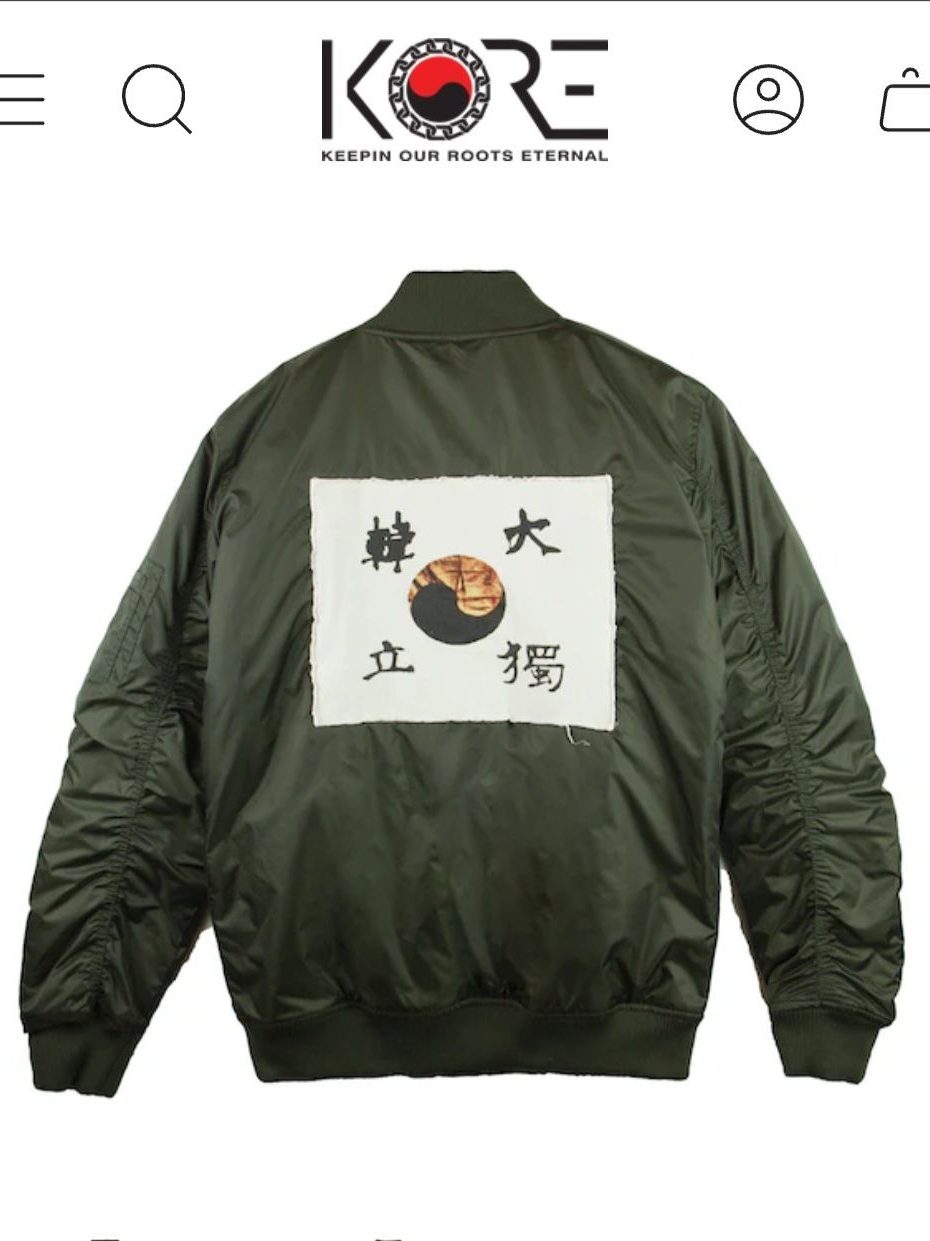
Representing Ahn Jung Geum
Ahn Jung Geum was a revolutionary and activist for the independence of Korea from Japan in the early 1900’s. Unfortunately, he is known for assassinating Ito Hirobumi, the first Japanese Resident-General of Korea, on October 26, 1909. He was later executed in 1910, but just before his execution he left these last words:
Before his death, the Japanese government allowed him to finish his writings and calligraphy calling for the peace among all East Asian nations. Some of his calligraphy included his bloody handprint and writings in his own blood, which included what is now known as the Ahn Jung Geum Flag. Ahn’s is still a symbol of Korean resistance and national pride. His legacy lives on through memorials, writings, and continued recognition of his commitment to Korean independence and his famous call for peace in East Asia and unity among nations.
Willingly Representing Korea, the History and the Culture
What I have come to realize is that I have inadvertently been representing Korean culture for almost 7 years now. Since I started this blog and since my friends and family know how deep I am into Korean culture I am usually the go to when they have any questions. People’s interest when asking questions goes beyond interest in K-Pop, but now K-Dramas with the recent interest in the West with the success of the movie Parasite and the multiple seasons of the series Squid Games. Unfortunately, people’s curiosity also includes the unfortunate Itaewon Halloween tragedy in 2022 and the short declaration of Marshall Law in 2024.
People have turned to me to have discussions and clarify anything they may not understand in terms of Korean culture and customs. Could these same people just use google to find out more information, absolutely. However, they feel confident in my knowledge and respect of Korean culture knowing that I will give it to them direct and correct. In addition, I have found a way to correlate and connect for them not only the differences, but the similarities between Korean, Western and Black American cultures to create better understanding.
After doing my own research into Ahn, I learned how this revolutionary paralleled some of the ideals of Black American revolutionaries throughout American history. I somehow felt connected even more to what this jacket represented. I guess there was a reason why I was so draw drawn to this bomber from the very beginning. I ultimately decided to buy the jacket.
So as I wear my new Ahn Flag Bomber, I am prepared to explain what the flag means, what it represents and how I as a Black American relate to the Ahn Jung-Geum fight for his people, their freedom and for all Asian nations to respect each other and find unity.
What I Have Learned
I am in no way the ideal representative for Korean history and culture, however my appreciation of Korea’s history and culture is still something I explore with reverence and respect. I know that this also means that through this blog and my everyday life, there are others that look towards what I represent as an outsider who has taken the time to learn the language, culture, and history. I then present it to those that are also in their journey into understanding and appreciating Korea and its culture beyond entertainment. I wish more artist and entertainment companies in South Korea did this, especially with how interwoven hip & hop and R&B is within K-Pop music. There is rich and deep history of the struggles of Black Americans that shaped these genres and the cultural fashion styles that developed from it, but that’s a conversation for another time.
I genuinely believe that in order to fully appreciate a culture’s offerings in art and entertainment it starts with also understanding some of the cultural and historical foundations that make it unique or how it can parallel your own culture and history. It is possibility that we are not that far removed from one another regardless of nationality. We share a commonality, that if we took the time to look closely, we could learn how to appreciate each other’s culture in a way that may not feel like appropriation.
Until Next Time……
To learn more about the topics discussed in this article please click on to links throughout. To learn more about Motown Records and the ways it has shaped the K-pop industry please click on the links to read the articles below:
Motown Walked So K-pop Could Run: The Overlooked Connection Between Two Music Giants
Behind the music: Motown – a pop factory with quality control
 The Melanin Ajumma