아니요! 만지지 마세요! No! Please Don’t Touch!” This may be one of the first phases in Korean that some Black foreigners learn while spending any type of time in South Korea. Whether you are there for a week or two as a tourist, there for a few months as a foreign exchange student or have made the brave decision to move and become an expat, you will at some point become the proverbial “unicorn” to many. You may be asking yourself why I’m using this term when referring to Black people as a “unicorn” since the word is typically used to describe a mystical fantasy creature written in books, movies, and various forms of entertainment. Although South Korea is rated as one the most technologically advanced and progressive among OED (Organization for Economic Co-operation and Development) countries, it still has one of the most homogeneous societies of any OED country. Therefore, making it one of the least racially and ethically diverse countries in the world. Hence, whether from the West or from one of the over 100 countries from the continent of Africa, Black people are the “unicorns” in South Korea.
I understand the desire for people to want to touch the hair and even the skin of a black person they may have only read about or seen in television shows and movies. However, for Black Americans, specifically, this display of curiosity can be a cause of discomfort deeply rooted in the racist and violent history of the diaspora in the United States and other parts of the world. For decades Black people in the U.S. and Europe were put on display in markets for sale and in human “zoos” as exhibits for entertainment. People intending to purchase a slave would poke and prod to examine humans to see if they were a valuable investment and fit for work. This would include examining their hair, skin, teeth, and body structure. Sometimes this would include examining genitalia of both men and women for the potential of breeding to produce more slaves, or for female slaves to be wet nurses for slave owner’s children.
For those that are deeply aware of the history of Black people around the world, this would include the spectacle of human zoos starting in the late 1890s throughout the United States and Europe.
Human Zoos
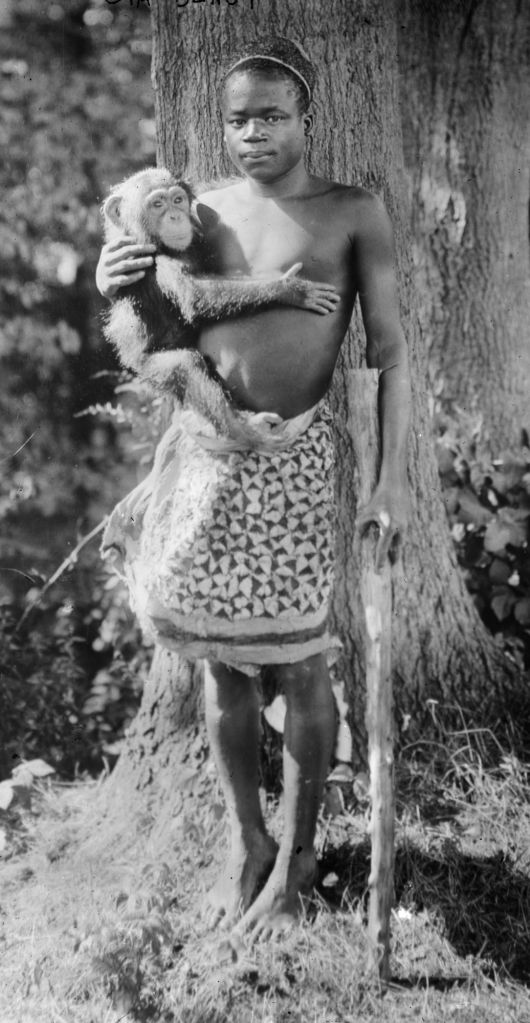
Human Zoos were a phenomenon in both the United States and in Europe in the late 1800’s and early 1900’s. These “zoos” consisted of displaying indigenous people, including indigenous Americans, Asians, but typically African men and women in enclosed cages and viewing pens for paid exhibition. For many it was entertainment to be able to look at, touch and comment on the features of captured, enslaved Africans in a “safe” environment. Often these men and women in exhibitions were mistreated, malnourished and health ignored while in these zoos.
One such zoo in the United States was the Bronx Zoo in New York City. In September 1906 they created a new exhibition displaying a Pygmy man named Ota Benga from the African Congo. This exhibition was in the Monkey House on the zoo’s property. It was meant to highlight the “missing links” between primates and man in the “lower” stages of human evolution. However, this was just one of many human zoos displaying enslaved Africans in the United States during the twentieth century. The documentary INHUMANE ZOOS detailed the creation and horrors of these types of exhibitions. It also explores how these zoos were put to an end and how the history of these institutions is still being hidden and re-written.
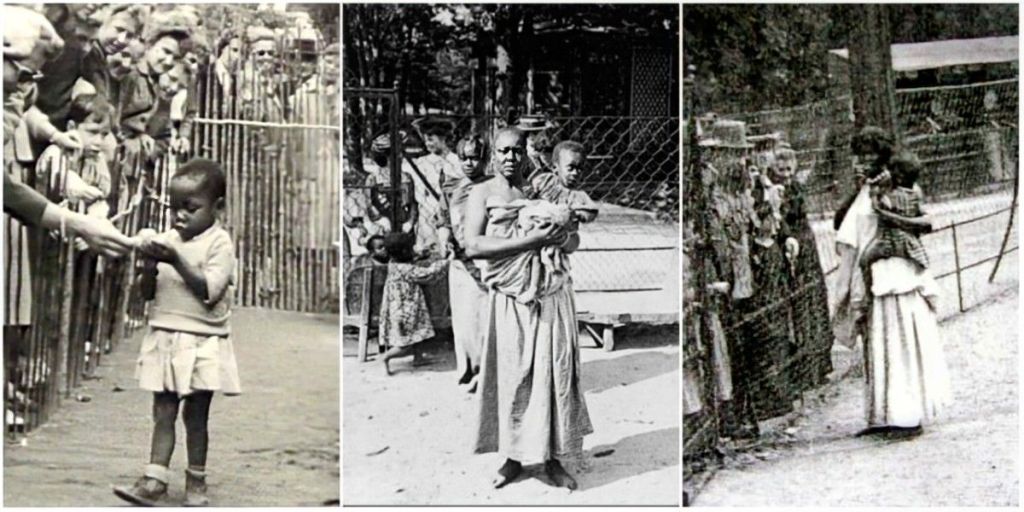
In the late nineteenth and early twentieth century these human zoos could be found in Paris France, Hamburg Germany, London England, Barcelona Spain, Moscow Russia, and throughout the United States. These zoos were steeped in both curiosity but also colonialism as explorers, such as Columbus, would sail to the Americas, bringing back some of the indigenous people with him.
In Europe, these human enclosures would be set up at World Fairs as exhibitions. Negro Village was an exhibition set up at the 1878 and 1889 Parisian World Fair that displayed more that 400 indigenous people visited by approximately 28 million people during this time. Often this exhibition would display humans in a “natural or indigenous habitant” like structures. One such exhibition was during the 1900 World Fair in Paris, in which the enclosure was modeled as living in Madagascar displaying humans in cages often semi or fully nude.
The Black Experience in South Korea
Since my interest and exploration into Korean entertainment, culture, and history in the past 8 years, I have taken a closer look at the history and experiences of Black people, especially black Americans living in the country. Recently I came across a YouTube channel called Korea Unfiltered, which explores the untold stories of expats living in Korea as well as first time visitors. My “for you page” suggested a recent podcast from this channel titled “I was NOT mentally ready to live in Korea” (Ep.45). In this episode a young woman in her mid 20’s describes her experiences moving and living in South Korean at two different intervals. One of her many fascinating stories accounts her experience with random Korean citizens, wanting to speak to her and touch her.
She recounts the details of a memory of riding a commuter train in Daegu and having a young boy, who was staring at her, whisper to their mother “Mom look, there’s a foreigner. I’ve never seen someone with her skin before. She smells like chocolate.” He looks at her [the woman telling the story] and ask in English, “You chocolate.” She goes on telling the story of her telling the boy no she’s not chocolate. The young Korean boy doubles down and ask if she taste like chocolate and tries to lick her arm. His mother pulls him away from our storyteller quickly, aware that her son was about to lick his fantasy chocolate women.
Ummmmm, HELLO, LITTLE BOY 만지지 마세요! That would have definitely been my response. But wait…THERE’S MORE!! On the same train ride she had an older Korean woman run her hand down her long curly natural hair responding “Wow, so soft” without saying hello or greeting her before walking away. Thankfully, these were the only truly culturally shocking moments within her intervals of living in the country.
She explains that her Korean co-workers at the institute she worked at explained that Daegu, the 3rd largest city in South Korea, had extraordinarily little foreigners, specifically Black foreigners living and working within the city. They were trying to explain that these people meant no harm. Therefore, for so many like her and other Black foreigners, they were essentially the proverbial “unicorn.” She expresses that she may not have mind if people tried to at least engage her in conversation and at least asked before trying to touch her skin or her hair. She understood that their responses were based on ignorance and curiosity, but also expressed the act of stroking someone’s hair like a pet was shocking.
It is easy to say they were merely ignorant of how to approach someone from another race that they are not directly familiar with. But for a second lets just explore what the term ‘ignorant’ really means. By definition, according to Cambridge Dictionary, ignorance is not having enough knowledge, understanding, or information about something.
South Korea is one of the most technologically advised countries of the modern world. They boost about having free high-speed internet available to all citizens and almost any visitor. Even in the countryside and rural areas WiFi is available to get online and explore the internet. With all of this technology available, they have the opportunity and ability to educate themselves outside of traditional means, such as a library or formal education. Yet, when it comes to diversity of race, ethnicities, and the experiences of other cultures, some still choose to remain ignorant.
Exposure at Home
Black Creatives in the Korean Music Industry is an article I wrote in 2022 that explores the vast number of Black songwriters and producers that have been contributing to the K-Pop music industry for almost 20 years. Some of Koreas top 10 K-pop songs were either co-written or produced by Black artist. These songs include EXO’s Call Me Baby, NCT127’s Highway to Heaven, Shinee’s Don’t Call Me, and BTS Jungkook’s My Time. Although this information is very public, it is a rarely promoted aspect of the industry. Why, who knowns and I will not speculate on why companies such as SM Entertainment do not highlight such behind-the-scenes talent.
Although these black artists are in the background of music production, recently there has been advances in highlighting Black artist at the forefront as Idols. There is Fatou of girl group Black Swan who is of Senegalese descent raised in Belgium. In addition, there is Manon of girl group Kateseye who is of mixed Ghanaian, Swiss and Italian heritage, raised in Switzerland. Although ethically and culturally different, both Fatou and Manon share the shared experience of being a novelty in the world of Korean Pop music.
Subsequently, you also have the exposure of Black people who although ethically Black, yet, integrated into Korean culture from an early age. Johnathan Yiombi and his family fled from the Democratic Republic of Congo as political refugees when he was very young. Since the age of 8, he has assimilated to Korean culture and traditions, including becoming fluent in Korean. He has become a raising star in Korean entertainment, appearing in variety shows and series such as Knowing International School, King of the Mask Singer, Netflix’s Zoombieverse, and Run Jin. His younger sister Patricia is also a television personality, who has spoken about feeling accepted within Korean society. Although these two are notable examples of those that have made a home for themselves and flourished in a homogeneous society, some others have found themselves on the receiving end of hate and ostracized from a community that once accepted them.
When Being Black Is Too Much
Korean Entertainment personality Sam Okyere, from Ghana migrated to South Korea in 2009 to pursue an engineering degree at Sogang University. During this time, he started booking small background roles in dramas and a few modeling gigs. His breakout was an appearance on Hello Counsellor, a television talk show, to discuss the difficulties he faced being black in Korea. This appearance led to other bookings for Korean variety programs such as Abnormal Summit, Running Man, and Knowing Bros. His popularity was due in part to his good looks, tall stature and and his fluency in Korean. At one time, before 2020, Sam was considered the most famous black man in South Korea, even earning a spot in 2017’s Forbes 30 Under 30 Asia. However, that all changed in August 2020 when he used his social media platform to speak out against the use of blackface (dark makeup worn to mimic the appearance of a Black person and especially to mock or ridicule Black people) in a photo that had been circulating around South Korea from a recent high school graduation.
For context, the Korean high school seniors share a tradition of dressing up (cosplay) and posing for unique yearbook photos that represent whatever the trend is for that year. In 2020 there was a viral video of “Dancing Pallbearers” in Ghana also known as coffin dancers. Parodying this video, the students dressed up in suits, hats, and glasses, similar to what was worn in the video. However, they also made the decision to paint their faces in dark brown face makeup to “fully capture” the look of the Ghanaian pallbearers. A simple Google or NAVER search would have explained that painting your face as another race, regardless of that race is often looked at as being offensive. However, for black people in particularly, regardless of your country of origin, this gesture is associated with racism and negativity.
Being from Ghana, Sam felt the need to speak out on this matter publicly, denouncing the photo regardless of the intention. He choice to use his fame and social platforms to educate and have honest discussions on the topic. He was met with angry and often disrespectful comments from many Korean citizens who quickly reminded him that he was not Korean regardless of his assimilation into Korean society. In that instance, Sam lost acceptance and his career due to his public stance. Ultimately, he had to pull back from the public spotlight. People, who were once welcoming, amazed and entertained by his presence, were now telling him to shut up and go back to Ghana. It makes you wonder was Sam ever, truly accepted as a Black man in South Korea.
Eventually in 2023, Sam slowly started to make public appearances again. He addressed the controversy by appearing on an episode of a South Korean talk show called Attack on Sisters. He apologized for any past indiscretions that came up about his past behavior including some xenophobic gestures and remarks. He also apologized for the way he criticized the Korean public about their “ignorance” on the subject matter of the use of blackface. He expressed his desire to continue to live and work in Korea as he had been for the past 13 years.
https://youtu.be/EH8R5eB8ioo?si=uW1EE3bZsliJjXw3
A Foreigner in a Foreign Land
There are millions of expats living and working in hundreds of countries all over the world. In South Korea alone there is an estimated 2.5 million expats as of 2023, which makes up approximately a little under 5% of the country’s total population. Among this population, other Asian ethnicities from countries such as Japan, China, and Thailand make up much of the expat community, followed by Caucasians, especially from European nations, with Blacks and Latinos from various countries representing a small percentage of the expat community.
Yet with the minuscule percentage of Blacks calling South Korea home, black American R&B, Hip-Hop and Hip-Hop street style, and culture influences one of South Koreas largest exports, K-Pop. Although Black American culture is heavily embraced, even influencing the MZ Generation, the people connected to this culture are still an anomaly and the unicorns within Korean society. There needs to be a greater emphasis and a larger discussion as to how there can be respectful coexists within the adoptive land that many black expats call home.
There are hundreds of content creators who have dedicated their content and channels to exploring and speaking about not only their experiences, but other’s experiences about being black in South Korea. Also, exploring how South Koreans view foreigners, especially Black foreigners living and working in this very homogeneous society. It is interesting to see the various situations some have had, which at times can be comical, but also heart breaking to see how ignorant some can still be in 2025.
Some lighthearted topics include experiences club hopping in Seoul, which at times also includes a commentary on how Black foreigners are excluded from some clubs. Ironically, some of these are Hip-Hop and R&B clubs, in which Black Americans are the foundation of this genre. In addition, how older Korean male taxi drivers will change the radio station to Hip-Hop music for Black passengers. Could this be an example of stereotyping, or could this be viewed as the driver just doing his best to make his foreigner passenger feel comfortable.
The opposite of these lighter experiences would include some dating horrors of finding out that a Korean male or female was only dating you for clout with no intentions of a sincere relationship. Or meeting the parents of someone you’re dating and having them leave the restaurant once they saw you were a Black foreigner and not the white foreigner, they thought they were meeting.
** Check out these content creators for more information:
Sisislessthan3: https://youtube.com/@sisilessthan3?si=ZhQxPKeHaoLrl_S4
K Explorer: https://youtube.com/@kexplorer?si=A8WBTrHrhhyTfmmi
Megan Moon: https://youtube.com/@mrsmeganmoon?si=qaZvWV1Zi0GIHMos
The Black Experience (Japan and Korea): https://youtube.com/@theblackexjp?si=yaNQ-hrYugzxdxG_
Asian Boss: (Korea and other Asian countries): https://youtube.com/@asianboss?si=ZJMxnST9YL5Z7HBM
What I Have Learned
With great power comes great responsibility.”-Voltaire & Uncle Ben Parker (Spider-Man comics)
There is no right or wrong answer when it comes to integrating into homogeneous societies, especially when you are an anomaly among all the anomalies within that country. It has been 75 years since the Korean War in which, for many Koreans, was their first exposure to non-Asian foreigners. Even then, most of their exposure about other ethnicities and cultures came from periodicals and films that didn’t always portray positive views of particular ethnicities. Therefore, I understand that although I may not have signed up to represent the Black community everywhere I go, I may be one of few of Black people many have ever seen in person. That is indeed a great responsibility when how you respond to curiosity may set the tone for how they see and treat other Black people.
With that being said, South Koreans and other homogeneous societies that have limited exposure to Black people should approach their curiosity with consideration and respect. Just for a moment think about how it would feel to be stared at, skin touched, grouped, and have your hair felt and pulled without even a greeting or being asked. Also, if someone says “no” that should be okay too because no one owes you giving up their bodily autonomy just to satisfy your curiosity.
Ultimately, it all boils down to respect between everyone. I’m okay being the unicorn. I’m okay with people asking me questions if it is done respectfully and with an actual desire to learn about another culture and ethnicity. However, not all are so willing and to understand the history of how Black people have been treated and discriminated against all over the world, is to understand that it is not okay to just touch random people. Much like Uncle Ben’s words to his nephew Peter, he tried to instill in him to use whatever power he had to make sure it could benefit others. Although not necessarily a power, my Blackness does put me in a unique position to be a bridge between those who are genuinely curious about another culture they are not familiar with. And that works both ways. As long as all nationalities, ethnicities and cultures understand that we are all unicorns in some way, we can learn respectfully and appreciate each other’s differences.
Until Next Time…….
For additional resources on the History of Blackface, the Black Experience in South Korea or Sam Okyere, please click on the links below:
“Heard” but not seen: Being Black in South Korea
Blackface: The Birth of An American Stereotype
Deconstructing the Sam Okyere Controversy: A Conundrum of Perspectives
 The Melanin Ajumma