Back in January, I was scrolling through my Instagram, and I see a post by one of my favorite Black American comics Kevin Fredericks (KevOnStage) and to my surprise there was a clip of the recent Korean pop group Got7’s fan-meet concert Nestfest. The caption on the clip says, “He’s not a Delta.” Confused, I watched the entire clip, which is a fan cam of Park Jin Young, lead singer of this “multinational” Korean Idol group. While watching, I noticed exactly why Kevin made this comment. In this clip, JinYoung is wearing a beautiful black and red leather jacket in which the front displays the numbers 1913, and the back displays a specific branding of the Greek letters ΔΣΘ (delta, sigma, theta). I was instantly upset and wanted to throw my phone across the room. All I could say was “here we go again!” However, my dismay did not end there. Later that day, my TikTok FYP was littered with references, snap shots, and additional clips from the concert of not only Jin Young, but also member Mark wearing a different jacket in the same colors and same branding.
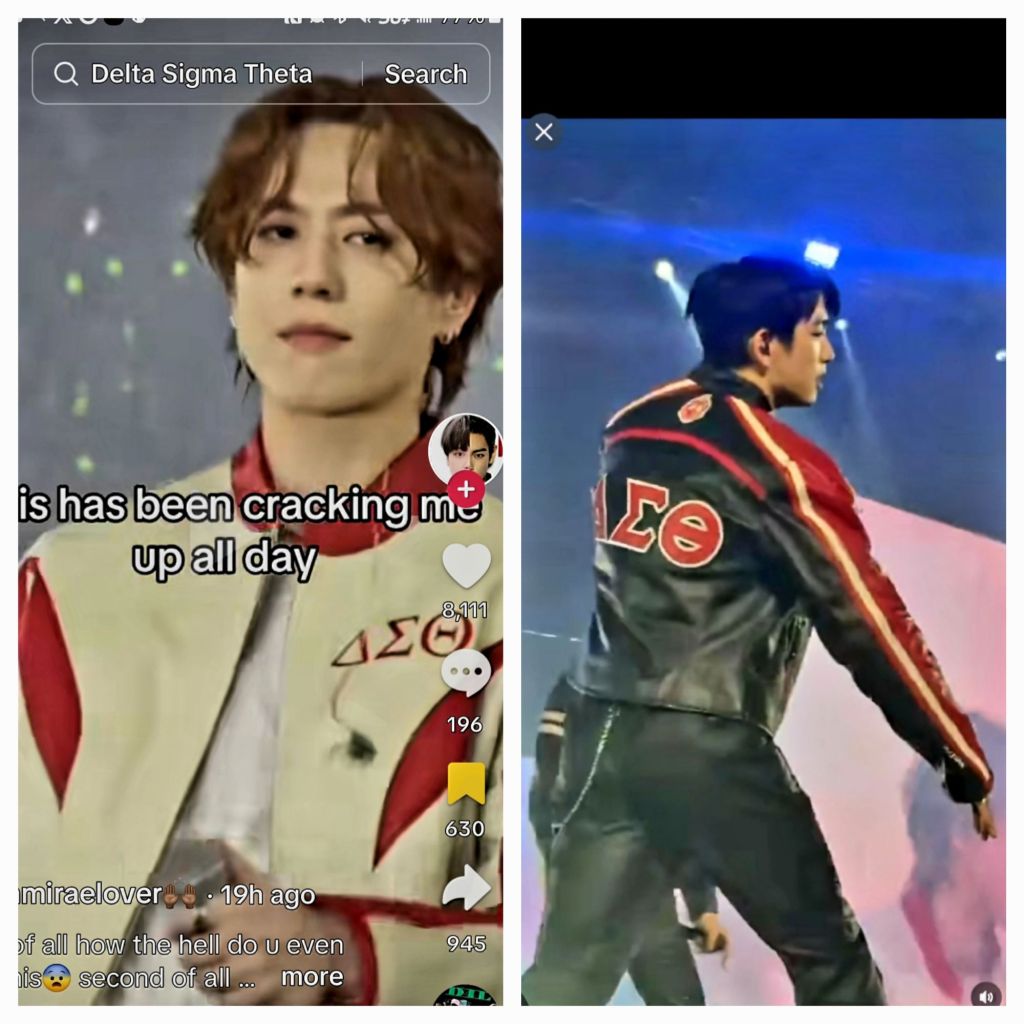
Some of you may not understand why JinYoung and Mark wearing those jackets caused such a response. Some of you may say it’s just a jacket. However there is deep cultural significants behind the jackets they were wearing. Those jackets were stylized to represent an over hundred year old historically black American sorority known as Delta Sigma Theta Sorority Inc. One part of an historic group of nine predominantly Black fraternities and sororities in the United States known as The Divine Nine.
History of K-Pop Cultural Blunders
If you are an avid fan of Korean Pop/Idol groups you may understand without further explanation why my internal thought after seeing these clips was, “here we go again.” This would not be the first time an idol group has been caught up in a controversy about the use of Western, or south East Asian cultural symbols, artifacts or clothing either on stage, in a music video or just as stylized fashion for the group.
In 2019, a member of NCT127 was called out for wearing a Lynyrd Skynyrd t-shirt with the symbol of the Confederate Flag. Originating from the United States during the Civil War, it is often seen by mostly Black Americans has a symbol for racism and hate and often used symbolically by hate groups in the U.S. The Korean stylist would not have known this bit of information significant to the Black American community, and understandably unfamiliar with the flag itself as Korean a citizen. However, taking the extra step to research the picture or symbol on the shirt as a secondary precaution would have avoided the disappointment of Black American K-Pop fans.
In 2020 the idol group BlackPink were called out for using Hindu religious symbols in the music video How You Like That, which has depictions of the Hindu God Ganesha.
Indian and South East Asian fans were quick to point out the use of this respected religious symbol posting their outrage on social media. One X post (then known as Twitter at the time of this post) stated;
The outrage did not stop at this social media post. There was even a Change.org petition created that received thousands of signatures to have the images removed. YG Entertainment, BlackPink’s label, heard their fans outrage and responded by editing the music video and removing the images of Ganesha. YG even posted a public apology;
Thank you to all Indian and Non-Indian Kpop fans who supported us in our fight to safeguard our religion and culture, it wouldn’t be possible without everyone’s consistent efforts ❤️ #YGapologise #MyCultureIsNotYourAesthetic #BLACKPINK pic.twitter.com/i6OVLJAJDN
–The Jakarta Post
There is no excuse for cultural unawareness when Google and Naver are free. Just like with the t-shirt and the image of Ganesha, a simple and quick image search of the back of that jacket would have indicated the origins and significance of that jacket. At most Korean entertainment companies, even the small ones, will employ at least one English speaking staff member. There are several idol groups within the last 10-15 years with at least one English fluent member, whether native English speaker or English as their secondary language. As for Got7, member Mark is an American born and partially raised English speaker. I am aware that being born in the United States or having the ability to communicate in English does not automatically mean that you have an acute understanding of all cultures and cultural practices. However, with English speaking staff and members, you do have the opportunity to put in a small amount of effort into research. This would provide an opportunity for any information, even basic info found written in English on international platforms outside of Korea, to be understood.
I am sure someone from Got7’s team could have done a Goggle or Naver search to see what those Greek letters were and if it was connected to anything important. I did a search of the image from member JinYoung’s jacket that was posted all over social media and the Google search brought up Delta Sigma Theta Sorority. They could have contacted someone in Korea or in the US to check and verify search results to make sure that using or wearing those jackets was not culturally inappropriate. This is why I continuously advocate for Korean entertainment companies to retain someone with multicultural awareness for consultation, to ensure instances like this do not continue to happen.
The History of Historically Black Colleges and Universities (HBCU)
Let’s explore a little deeper with a brief history on the foundation in which black fraternities and sororities were created, Historically Black Colleges and Universities, also referred to as HBCU’s. What is known as the Divine Nine of fraternities and sororities starts back at a time when education in the United States was segregated and Black citizens were not allowed to be educated along side White citizens in most parts of the country. Until the 1960’s almost all higher education (university) was segregated in the United States. There were some, yet limited options for Black Americans to pursue higher education at a college or university, however few were enrolled and allowed to complete degree programs.
To address this issue Black Americans decided to create their own institutions for higher education and the first university for Black students was established in 1837 by Richard Humphreys. Now known as Cheney University, the African Institute in Pennsylvania carried out a mission to to teach free Black Americans useful skills to gain employment. These skills included reading, writing, basic math, industrial arts and even religion. By the 1850’s at least three more black colleges and universities were established. With the passing of President Abraham Lincoln’s Emancipation Proclamation in 1867, between the years of 1865-1900, an additional 9 colleges and universities were created. By the 1960’s almost 101 HBCU were created with Morehouse School of Medicine being the last one in 1975 (Thurgood Marshall College Fund). These institutions were open to all who wanted to attend including white students. However HBCU’s are also known as PBI, Predominantly Black Institutions, in which the student body is made up of more than 50% of the entire student population.
Those few students that were able to attend Predominantly White Institutions (PWI) often felt a lack of inclusion in these institutions. To find connection and community on campus, Black students had to create there own clubs, which included fraternities and sororities, establishing the first of what would be later referred to as the Divine Nine.
Here’s a more detailed look at the timeline and key events: (Google AI created)
· 1954: The landmark Brown v. Board of Education Supreme Court decision outlawed segregation in public schools, setting the stage for broader desegregation efforts.
· 1950s-1960s: Legally enforced racial segregation in education was generally outlawed, and other nondiscrimination policies were adopted.
· 1964: The Civil Rights Act prohibits discrimination based on race in public facilities, including schools, and Title IV authorizes the federal government to file school desegregation cases.
· 1965: The Higher Education Act is passed, further supporting desegregation efforts.
· 1960s-1970s: The Civil Rights Movement gained significant support, and by the 1970s, previously non-Black institutions began enrolling Black students and hiring Black faculty, staff, and administrators.
· 1971: The Supreme Court in Swann v. Charlotte-Mecklenburg Board of Education approved the use of busing to achieve desegregation.
· 1988: School integration reached an all-time high, with nearly 45% of black students attending previously all-white schools.
The History of The Divine Nine
As previously stated, Black university students subjected to a lack of inclusion in social organizations, such as Greek/Fraternal organizations, on campuses at predominately white institutions, forced them to create their own social spaces to seek out community and support. This developed into the start of the first Black Greek Letter Organizations (BGLOs) in 1903 with Alpha Kappa Nu. However, due to a struggle in keeping steady membership, the organization disbanded. Just three years later in 1906 at Cornell University, Alpha Phi Alpha Fraternity, Inc was established as the first BGLO. In 1908 at Howard University HBCU (Historical Black College and University), Alpha Kappa Alpha Sorority, Inc was established as the first BGLO sorority. Subsequently, between 1913 to 1963, seven additional Black Greek Letter Organizations (BGLOs) were established: Delta Sigma Theta Sorority, Inc, Kappa Alpha Psi Fraternity, Inc., Omega Psi Phi Fraternity, Inc., Phi Beta Sigma Fraternity, Inc., Zeta Phi Beta Sorority, Inc., Sigma Gamma Rho Sorority, Inc., and Iota Phi Theta Fraternity, Inc. With the creation of these five fraternities and 4 sororities, what is known nationally and internationally as the Divine Nine was formed.
The National Museum of African American History and Culture in Washington D.C. describes these organizations as significant parts of the Black American experience; “These associations were established on the principles of personal excellence, racial uplift, community service, civic action and kinship. Their emergence coincided with significant national developments, including the rise of Jim Crow laws, the popularity of scientific racism, and widespread racial violence and prejudice”.
Each organization has there own policy, procedures, guidelines and laws. In addition, each fraternity and sorority is represented by the Greek letters associated with their name and individualized combination of colors that are unique to set them apart from each other. Alpha Kappa Alpha Sorority, Greek letters are AKA and their colors are salmon pink and green apple. In compression the Delta Sigma Theta Sorority, Greek letters are ΔΣΘ and their colors are crimson(red) and cream. These unique letters and colors are a global representation of each organization and symbolizes a sense of belonging and community established in their pledge to a life a community service and uplifting their community. It is not until potential members are vetted and go through a private, lengthy and rigorous pledging process are accepted members allowed to wear these colors and all paraphernalia associated with the organization. To make this very clear, no one, absolutely no one outside of the members of the Divine Nine and their organizations are allowed to wear any of the paraphernalia as it represents more than just fashion, but a pledged commitment to each other and society as a whole.
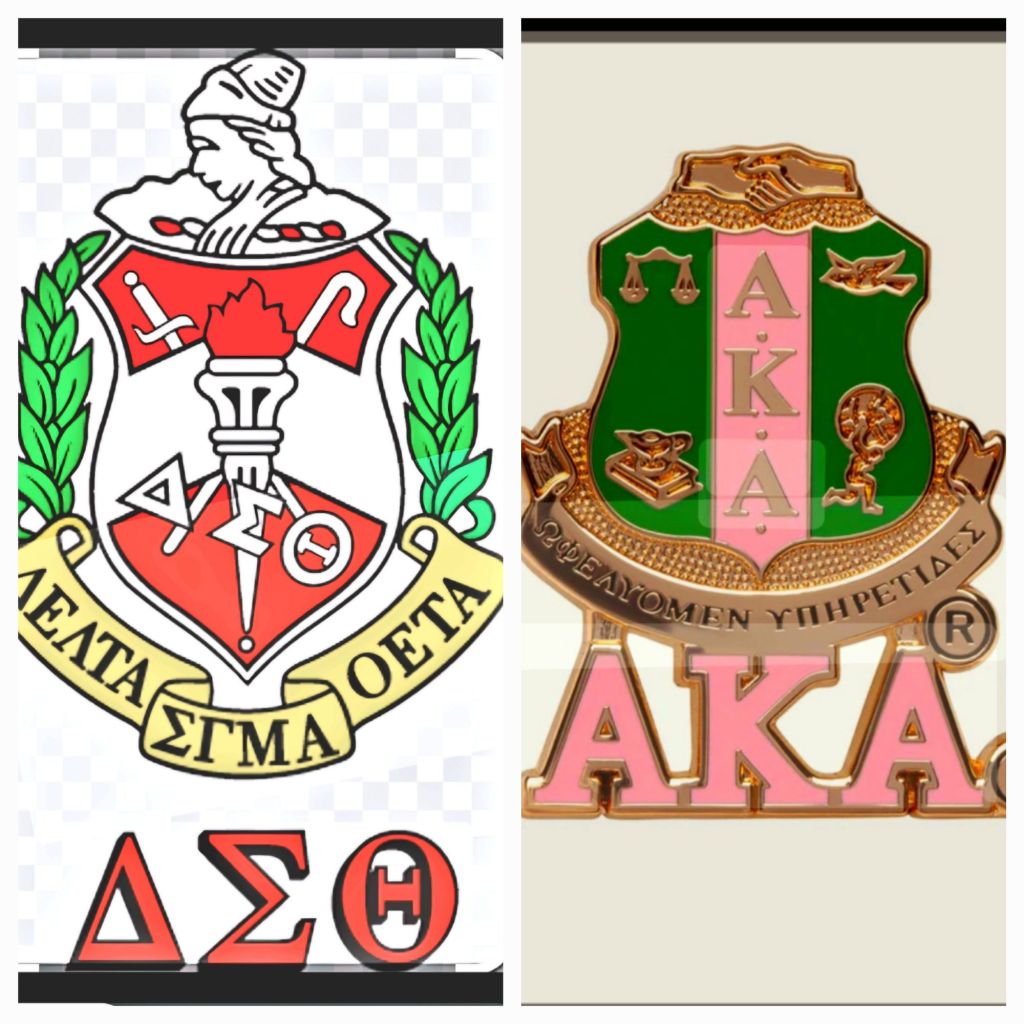
For additional information and brief history of each BGLO’s please check out The Divine Nine: History of Black Sororities and Fraternities. https://www.bestcolleges.com/blog/divine-nine-history-black-sororities-fraternities/
Paying Attention to the Details for a Global Audience
Within 24 hours a plethora of videos and comments on Black Tok, content for and by black creators specifically addressing issues and topics of interest to the black community, scratching their collective heads wondering why and how did Got7’s stylist even get there hands on this black sorority’s branded jackets. A friend of mine who is a part of a fraternal order explained that apparel and some regalia from the Divine Nine and other sororities and fraternities can be ordered and purchased online. Many of these online sellers did not check if a customer is a member of these organizations. Therefore, leaving it open for anyone to purchase.
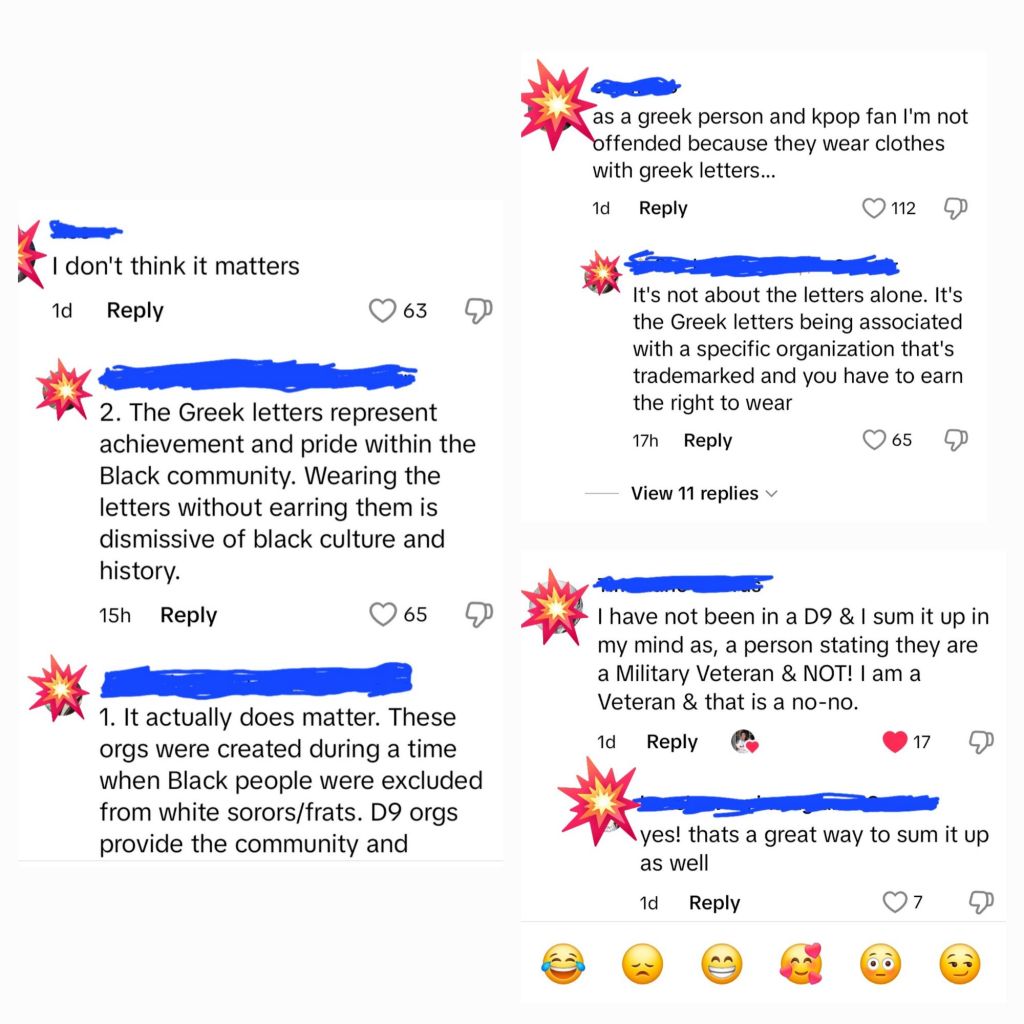
On social media post, many in the black community, especially Black American K-Pop fans, were upset that yet again Black America culture and history was used for mere fashion without context. Although, most understood why this would be unsetting, too many expressed unsympathetic responses, that included comments such as “What’s the big deal. Is this something to really get upset over”, “ Seriously, It’s just jackets” and “I don’t think it matters.” One person compared the wearing of the jackets to wearing military veteran paraphernalia and not being a veteran or serving in the military. I compared it to wearing the military uniform or paraphernalia of another country in which you are not a citizen. Regardless of the race or ethnicity of those that were indifferent to what some found upsetting, the feelings of others deserves respect and safe spaces to express feelings and thoughts openly.
At a time when Korean pop music and entertainment globally is at a all time high, putting in the effort to research every detail matters. Everything from English lyrics, music video design, to the clothing choices stylist make needs to be scrutinized for the details. Taking that extra time in the beginning will ultimately save time in the future from having to apologize to fans, re-edit music videos or negative social media presence. After almost 8 year as a fan of K-Pop, I have become used to the occasional blunder in cultural unawareness. It happens less often than it did even 5 years ago, however, now more than ever, more eyes are on K-Pop and its influence on the world. When images of something that affects an entire community outside the base of K-Pop. It is when these images reaches non-fans that paying attention to the details matters the most. There was a time when only certain media outlets would report or repost video clips or pictures of idols for entertainment news. Now, when there are multiple platforms that can post, repost and report an image within a matter of minutes, entertainment companies and labels need to protect the image of these idols and their brand now more than ever.
What I Learned
Months later, I wonder if the Got7 team saw the social media discord, especially from members of the Divine Nine and the Black American community at large. I wonder if they really understood the blunder that was made for the sake of cool fashion. For all they knew those Greek letters and styling could have represented something nefarious and derogatory. Most likely they probably just thought they were cute and stylish, something that would work during the concert and would fit the image of the group. I truly do believe they meant no harm and did not have ulterior motives. But, with Got7 just coming back after a 3 year hiatus, and just releasing their new album, the last thing they needed was negative social media presence. Even though this controversy affected a small demographic in the much larger make-up of Ahgase’s (Got7 fandom name), it still upset some and even amused some non-K-pop fans. It also put into question with members of historically black sororities and fraternities how far reaching there branding is and how vulnerable their branding and representation is outside of the United States.
My goal with this article is to educate those that have all of a sudden been made aware of a culture and community they may not have know about prior to this situation. I can just imagine how many non-Black K-pop fans wondered what is Delta Sigma Theta. I hope that they did what the stylist failed to do and researched to enlighten themselves on a 100 plus year old organization that would gladly welcome the curiosity of Black American history and culture. As long as you leave their paraphernalia to them.
Until Next Time…….
*(For more information on the creation of HBCU’s, and the history of the Divine Nine, please clink on the blue hyperlinks throughout the article)*
 The Melanin Ajumma
One thought on “Here We Go Again: Korean Entertainment Lack of Awareness”