
From October 28th-November 11th, the Korean Cultural Center of New York (https://www.koreanculture.org/) in collaboration with Nongshim Shin Ramyun (https://nongshimusa.com/) and 26 participating Korean restaurants within the K-Town area of New York City promoted Korean Culture through the universal language of food. Specially designed K-Culture Passports were available for pickup at KCCNY, participating restaurants and Shin Ramyun Food truck to use during the two week event. This K-Culture Passport provided a 10% discount at the 26 Korean restaurants during Korean Restaurant Week from October 28th-November 11th. In addition, anyone with one of these passports could collect stamps at participating restaurants, the Shin Ramyun Food Truck or KCCNY to skip the line at the finale event the “Han River in NYC with Shin Ramyun.” Due to scheduling issues, I was only able to attend the finale event held at KCCNY.
A Little Bit of the Han River in NYC
The Hangang River or Han River, is a major water source that spans 319 miles running through three provinces, Gangwon-do, Chungcheong Buk-do, Gyeonggi-do and the capital of Seoul, making this the longest river in the Korean peninsular (https://www.koreatodo.com/han-river-top-attractions.).
Those familiar with Korean dramas or movies set in modern times have seen multiple scenes of couples, friends or families gathered in one of the 11 parks all along Han River, especially in Seoul. Often these gatherings will involve some type of picnic, with an assortment of snacks, beverages and food, especially ramyun often prepared at local conveniences stores right along the river. It is not unusual to see people set up tents spending all day with family playing games and relaxing along the river or friends having a few beers staying up all night drinking and having a good time.
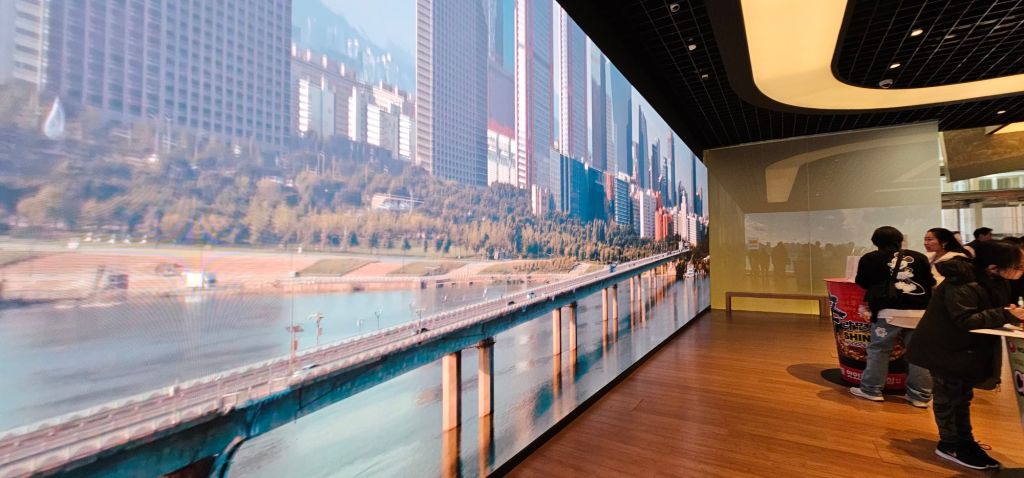
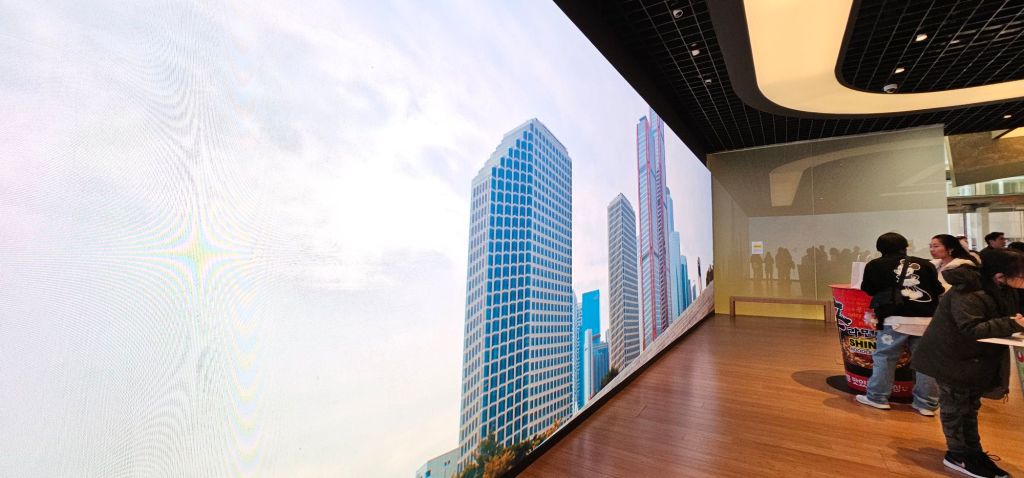
One of Nongshim family of ramyun is often a big part of these gatherings along the Han River, hence the finale of the K-Culture with Shin Ramyun was the “Han River in NYC with Shin Ramyun” experience at Korean Cultural Center of NY.
Hmmmmm, RAMYUN
There were couples, groups of friends, families and loners, like me, standing online for upwards of two hours waiting to enter KCCNY to engage in the immersive experience of eating Shin Ramyun “along the Han River”. Once you get through the hour plus long line outside you enter to the sound of the latest K-Pop tunes and two massive screens playing a continuous loop of life along the Han River. Scenes of families playing on the grass, of couples taking in the views and friends playing a game of basketball in the parks along the river. Of course, no outing is complete without a streaming cup or bowl of ramyun.
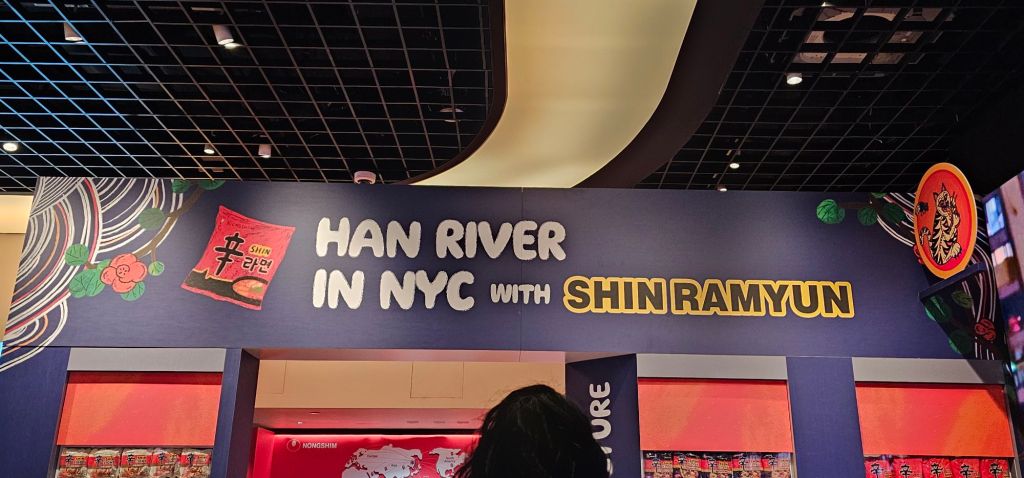
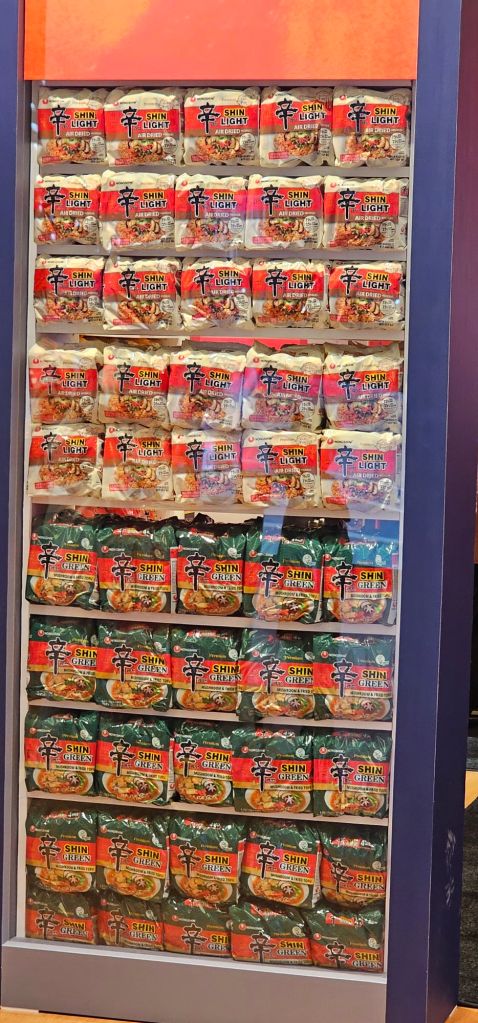
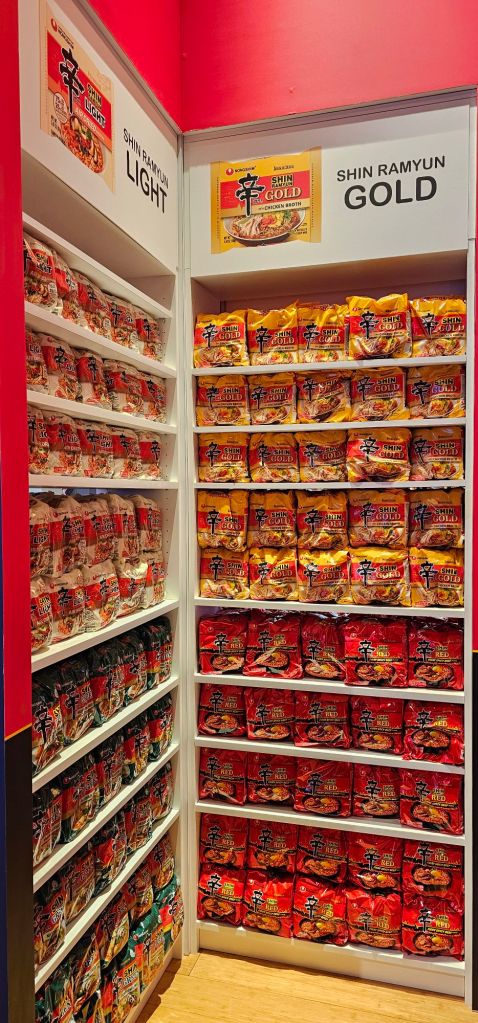
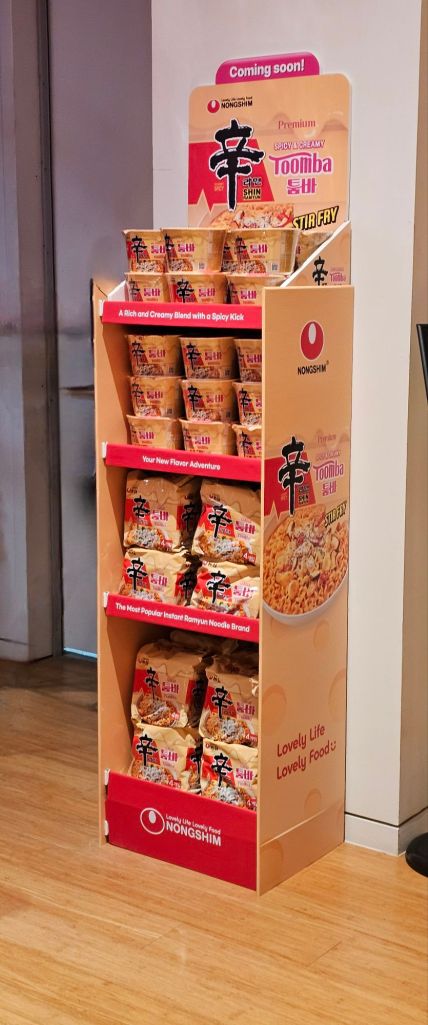
While surrounded by the sights of the Han River we waited upwards of another hour for the main event… RAMYUN. Greeting us was the Nongshim “convenience store”, displaying the Shin Ramyun family of favors from the original flavor, and the robust and hearty Black. A few that I have never seen before in my local H-Mart were the Light-which is non-fried version of the original, Gold-a chicken base booth boasting a fusion of American and Korean flavors, and Green-a plant based vegan option that still had the spice, although not as spicy, and plenty of dried mushrooms and fried tofu. This is the one I tried, and it was absolutely delicious. Spicy, rich in flavor and an abundance of mushrooms and tofu to make it a complete meal or snack. They also had on display the newest member of the flavor family Toomba which is a spicy creamy version of the Stir Fry Shin Ramyun already available in stores. This new flavor is due in part to the current trend of ramyun recipes on Korean SNS and is due for release in the near future.
Experiencing K-Culture in NYC
Unlike the convenience stores typically found in the U.S., especially in NYC, if you want a cup or bowl for ramyun you would have to buy a package, take it home, boil some water and add it to your ramyun cup or make your ramyun in a pot. However, typically, in Korea if you wanted ramyun immediately, you could make it right there on the spot using ramyun makers. These instant ramyun makers are electronic machines that are programmed to dispense the exact amount of water needed to fill your heat proof disposable container, that boils your ramyun for the appropriate amount of time to completion. These types of machines are very common in convenience stores that sell instant ramyun. Here is a video of a store in Korea that specializes in instant ramyun. https://youtu.be/9R74P9OCFGI?si=WdjIMLucD4oxOyHI
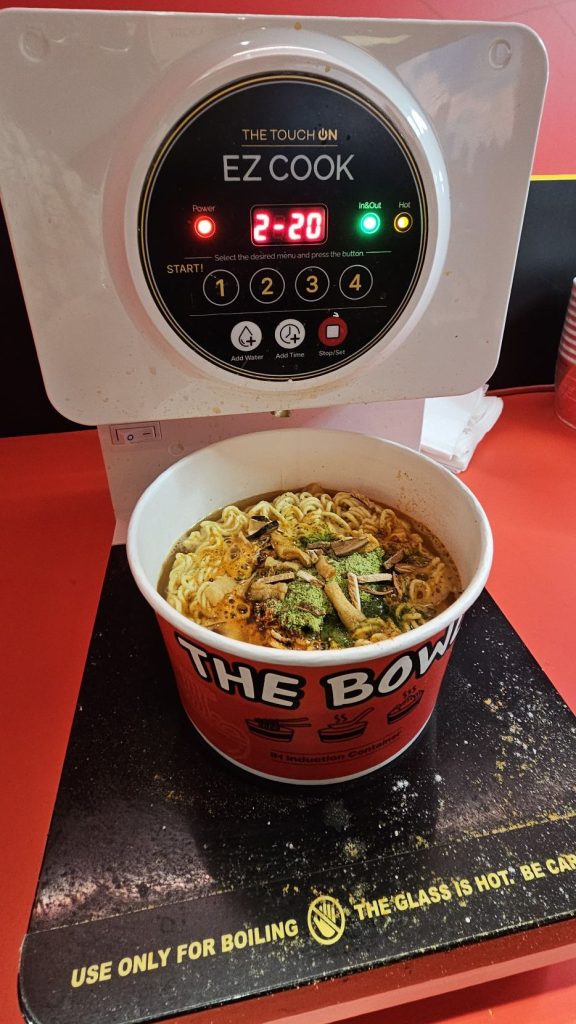
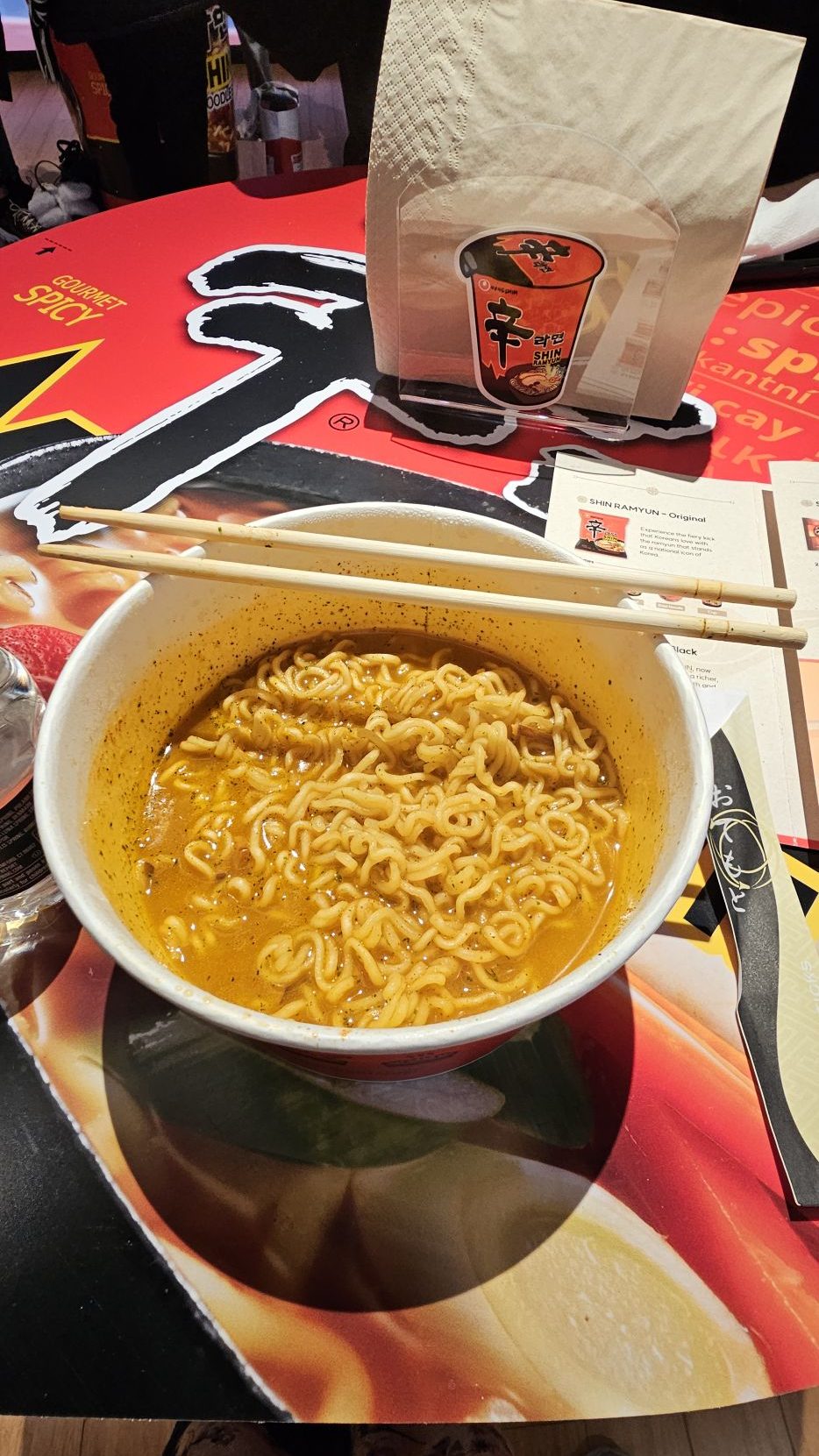
Now, thanks to Nongshim and KCCNY, I would be able to participate in this common Korean food culture experience first-hand. Once we selected one of the flavors available, we were greeted by a staff member who helped us prepare our ramyun for cooking at one of the machines. In little under five minutes, a steaming delicious bowl of ramyun was ready to take to one of the ramyun branded standing tables to enjoy.

Surrounding the event space were people of all ages talking, laughing, and slurping up delicious hot ramyun. Little ones no older than 7 or 8 years old eating big bites of noodles and sipping on hot spicy broth, with caution, taking in each mouthful of spicy goodness like champs. Others took breaks in between eating to take selfies or photos at the instant photo wall to keep or post a photo onto the wall.
Exploring K-Culture Beyond Food
Since the Shin Ramyun event took place inside of Korean Cultural Center New York, there was an opportunity to explore the other public floors of the center, including the gallery on the 2nd floor. On exhibit in the gallery is the artwork of Korean Artist Ik-Joong Kang (http://www.kangcollection.com/artists/ik-joong-kang).
Kang is an internationally acclaimed artist whose works aim to bridge East and West. At the core of Kang’s artistic vision lies a universal perspective that goes beyond the limits of race, nationality, age, gender, and nature. His work reinterprets ordinary materials and traditional symbols into deep visual stories. Kang’s monumental creations, including expansive installations made up of thousands of small components, symbolize the shared human experience. Each piece, whether it be a piece of glazed porcelain, a Hangeul tile, or a multimedia element, embodies a story, a memory, or a piece of cultural heritage. Currently, there are three instillations available for viewing in the gallery.
1392 Moon Jars (Wind), 2008–2010 (On loan from the Solomon R. Guggenheim Museum) is an installation of 1,392 glazed porcelain moon jars embellished with enamel paint. The Moon Jars, iconic in their simplicity and understated elegance, symbolize the enduring beauty and influence of traditional Korean porcelain. The allure of the Moon Jars lies in their purity and imperfection, which allow them to be both empty and capable of containing everything. This duality perfectly encapsulates Kang’s artistic vision-KCCNY.

- Photo by Kunning Huang / Korean Cultural Center New York
Throw Everything Together and Add, 1984-1996 (On loan from the Whitney Museum of American Art) this artwork encompasses 6,000 unique 3-inch canvases expressing the vibrant diversity of New York. This installation is the embodiment of the concept of Korean bibimbap, as it too has diverse individual ingredients that creates an entire dish. In a manner that anticipates the digital age, the way thousands of small canvases merge into a single, unified image mirrors the concept of individual pixels forming a complete picture. This installation exemplifies Kang’s experimental spirit, where diverse components interact to create an integrated and resonant artistic experience. It highlights his forward-thinking artistic vision, demonstrating how his work epitomizes the modern value of interconnectedness and reveals his genius as an artist ahead of his time-KCCNY.

- Photo by Kunning Huang / Korean Cultural Center New York
Hangeul Wall: Things I Love to Talk About, 2024 this center installation is the center piece of the Korean Cultural Center. Comprised of 20,000 3×3 inch tiles, measuring 26×72 feet it runs along the east wall of the center spanning from floor to ceiling. In May 2024, KCCNY launched a website with the collaboration of LG CNS, enabling visitors for more that 50 countries to create their own artwork in Hangeul using translation and coloring functions under the theme “Things I Love to Talk About.” Within two months, this project received 7,000 submissions in which through public online voting and artist reviews, 1,000 pieces were selected for this installation. As per staff at KCCNY The Hangeul Wall will be a permanent part of the center. The Hangeul Wall stands as a symbol of the rich cultural heritage of Hangeul and the universal freedom of expression, serving as a testament to our shared human narratives. Traditionally, walls are seen as barriers that divide and separate; however, the Hangeul Wall represents a different kind of structure—a wall of peace and unity. It transcends the conventional notion of separation to become a canvas of connection and harmony-KCCNY

- Photo by Taehyun Hwang / Korean Cultural Center New York
What Have I Learned
I realized that I sometimes take for granted the luxury of living in a city that offers the chance to observe, explore and become immersed in various cultures. As someone who loves Korean culture and all it has to offer, I am so glad that I had the opportunity to enjoy ramyun courtesy of Nongshim “Han River in NYC with Shin Ramyun” pop-up. This pop-up also created an opportunity to explore the new location of the Korean Cultural Center of New York, that has a multitude of engagements and activities from the Korean language library, art gallery, performance theater and special events. This entire experience reinforced my understanding of the privilege I have to access affordable authentic Korean food, goods and culture outside of South Korea.
This short and simple experience was the catalyst to seek out other inexpensive opportunities to expand my knowledge about Korea and Korean culture and history. So, I encourage anyone reading this to research where the closest Korean culture center or Korean society is near you. Unfortunately, for some, that may be 10 miles or 100 miles from where you live, however engagement online is also an option. Therefore, look online and sign up for emails from any of the Korean cultural centers or societies in your country, follow them on SNS such as Instagram or X (formally Twitter). Many of them offer virtual events or information on pop-up events that may come to a city near you. If you love Korean culture, stay engaged in all aspects the culture has to offer.
Until next time….
 The Melanin Ajumma